
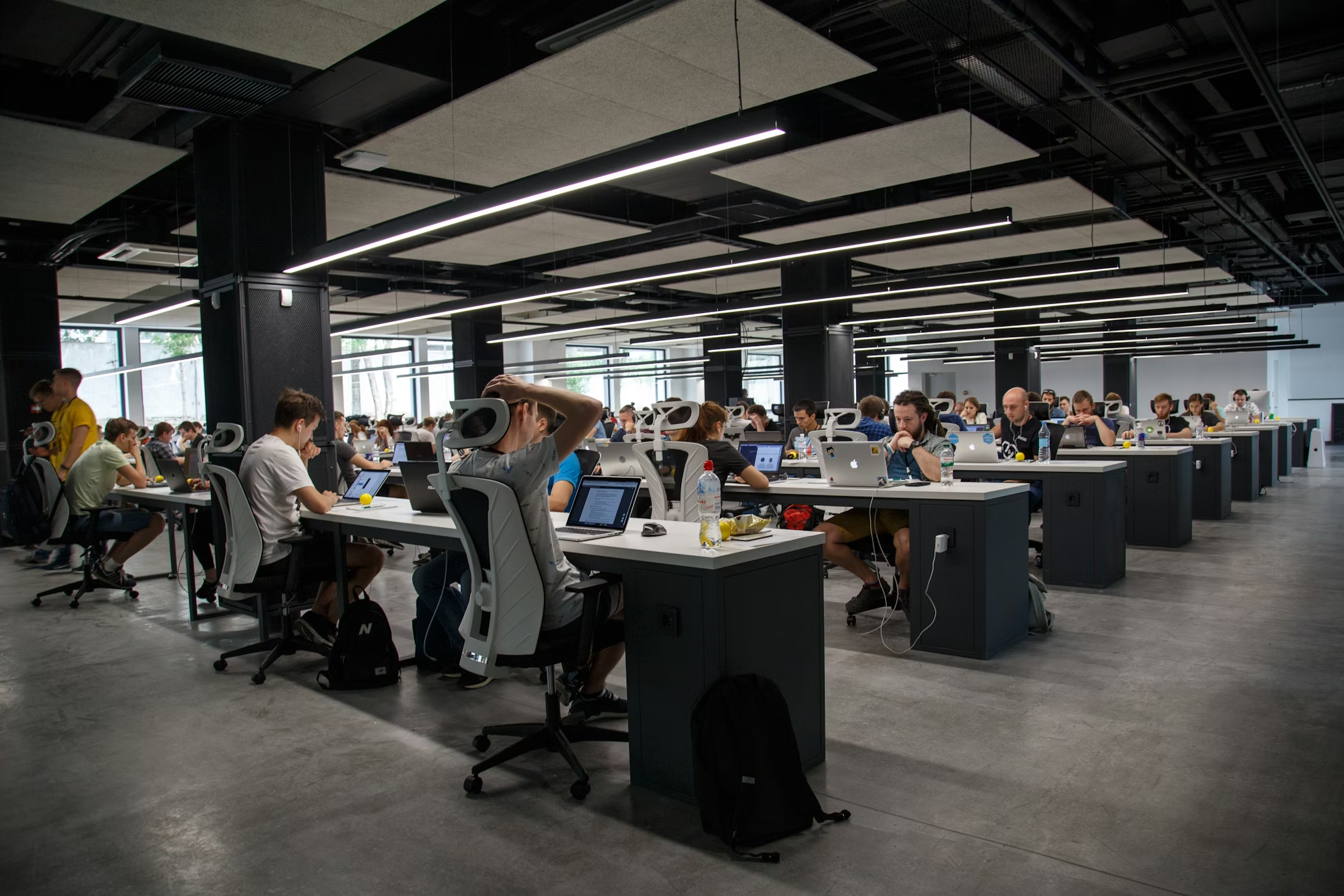
From artificial intelligence to cloud platforms and global connectivity, innovation is no longer happening in waves — it’s happening all at once.
A World Where Change No Longer Waits
Innovation has always been part of human progress. However, what makes today’s moment different is speed.
In the past, major technological shifts took decades to unfold. First, research happened. Then adoption followed slowly. Eventually, transformation arrived.
Today, that timeline has collapsed.
As a result, innovation is no longer linear. Instead, it is continuous, overlapping, and relentless. New technologies emerge, scale globally, and reshape industries almost simultaneously.
More importantly, this acceleration is not random. It is being driven by a unique convergence of forces that have never existed at this scale before.
First, Technology Is Building on Itself Faster Than Ever
One of the most important reasons innovation is accelerating is simple: technology now builds upon existing technology at extraordinary speed.
Previously, breakthroughs often required starting from scratch. Now, however, developers and companies are stacking innovations on top of mature platforms.
For example:
- AI is built on cloud computing
- Cloud computing relies on global connectivity
- Connectivity depends on advanced hardware and software
Consequently, each new advancement immediately becomes a foundation for the next.
As a result, progress compounds rather than resets.
How Emerging Technologies Are Quietly Reshaping Industries
Meanwhile, Cloud Infrastructure Removed Traditional Barriers
At the same time, cloud computing has fundamentally changed who can innovate — and how fast.
In the past, building technology required:
- Physical servers
- Large capital investments
- Long deployment timelines
Today, however, anyone with an idea and a laptop can access:
- Global infrastructure
- Scalable computing power
- Enterprise-grade tools
Because of this shift, innovation is no longer limited to large corporations. Instead, startups, independent developers, and even small teams can compete at a global level.
As a result, more ideas reach the market faster than ever before.
At the Same Time, Artificial Intelligence Is Acting as a Force Multiplier
If cloud computing removed barriers, artificial intelligence multiplied human capability.
AI now accelerates:
- Research and development
- Product design
- Software engineering
- Content creation
- Decision-making
Instead of replacing creativity, AI enhances it. Therefore, individuals and teams can now execute ideas at speeds that were previously impossible.
Moreover, AI systems learn and improve continuously, which means innovation no longer pauses between iterations.
How AI Is Quietly Reshaping Everyday Life
Additionally, Global Connectivity Enables Instant Scale
Another critical factor is connectivity.
Thanks to the internet, mobile devices, and digital platforms, innovation now spreads globally in real time. Once an idea works in one place, it can be deployed everywhere.
As a result:
- Products launch worldwide from day one
- Feedback loops happen instantly
- Improvements are deployed continuously
Because of this, innovation is no longer localized. Instead, it is global by default.
Furthermore, global connectivity allows innovators to learn from each other instantly, accelerating progress across industries simultaneously.
Meanwhile, Consumer Expectations Are Forcing Faster Change
Interestingly, users are no longer patient.
In today’s digital environment:
- Slow products are abandoned
- Poor experiences are exposed
- Outdated systems are replaced
As expectations rise, companies are forced to innovate faster simply to remain relevant.
Consequently, innovation has become a survival requirement rather than a competitive advantage.
At the Same Time, Startups Are Challenging Established Players
While large companies still dominate many sectors, startups are increasingly driving rapid innovation.
Why?
Because startups:
- Move faster
- Take bigger risks
- Focus on narrow problems
- Avoid legacy systems
As a result, they often identify opportunities that established players overlook.
However, once those ideas prove successful, larger companies adopt, scale, or acquire them — further accelerating innovation across the ecosystem.
Why Small Teams Are Building Billion-Dollar Products
Moreover, Competition Is Now Relentless and Borderless
In the past, companies competed locally or regionally. Today, competition is global and constant.
Because technology markets have low switching costs, users can move quickly between platforms. Therefore, companies must continuously improve or risk irrelevance.
As competition intensifies:
- Innovation cycles shorten
- Experimentation increases
- Risk-taking becomes necessary
In effect, competition itself has become an engine for faster innovation.
Meanwhile, Data Is Fueling Smarter Decisions
Another major driver is data.
Every digital interaction generates information. Over time, this data enables companies to:
- Understand users better
- Predict behavior
- Optimize products continuously
As a result, innovation is no longer driven by intuition alone. Instead, it is guided by real-world evidence.
This feedback loop dramatically shortens the distance between idea and improvement.
However, Speed Comes With New Challenges
Despite the benefits, faster innovation introduces real risks.
For example:
- Ethical concerns emerge faster than regulation
- Security vulnerabilities spread quickly
- Social and economic impacts are harder to predict
Therefore, leadership and responsibility matter more than ever.
The companies shaping the future must not only move fast — they must move thoughtfully.
Looking Ahead: Acceleration Is the New Normal
Innovation is not slowing down. In fact, all signs point to further acceleration.
As AI matures, infrastructure improves, and global collaboration increases, innovation will become even more continuous and interconnected.
Ultimately, the question is no longer whether innovation will happen — but how responsibly it will be guided.
Final Thoughts
Innovation is moving faster than ever because the world has changed — permanently.
Technology now compounds, scales instantly, and responds to real-time feedback. As a result, progress that once took decades now happens in years — or even months.
For businesses, creators, and users alike, understanding this acceleration is no longer optional. It is essential for navigating the future.
-
 AI, Cloud computing, Cyber Threat, Data Engineering, Open Source, Ransomware, Software Security, technews, Technology
AI Cyber Defense Pact: Why the Warning Matters
The AI Cyber Defense Pact Is a Warning the World Cannot Ignore Artificial intelligence is changing cybersecurity faster than many organisations can adapt. Now, some of the world’s…
Blog categories
- 5G
- AI
- Anthropic
- APIs
- Apple
- Assistive Technology
- Augmented Reality
- Automation
- Autonomous Agents
- Bioinformations
- Biotechnology
- blockchain
- Browser
- Business
- Capital
- climate
- Cloud computing
- collaboration
- cross-platform
- cryptocurrency
- Cryptovoxels
- Customer support
- Cyber Threat
- cybersecurity
- Data
- Data Engineering
- Decentraland
- Defi
- Digital Accessibility
- digital transformation
- Energy
- Engine
- Esports
- EVs
- Finance
- Fintech
- Gaming
- Gene Therapy
- GitHub
- GitOps
- Governments
- Healthcare
- Industry
- Investment
- Machine Learning
- medicine
- metaverse
- Modern Framework
- Modern Technology
- nanotechnology
- No-code
- Nvidia
- Open Source
- OpenAI
- PalmPay
- Programming
- Quantum AI
- Quantum Computing
- Qubits
- Ransomware
- Renewable Hydrogen
- Robotics
- Saas
- sandbox
- Serverless
- Smart Homes
- Smartphone
- software
- Software Security
- Space Technology
- Stablecoins
- Startups
- streaming
- Supply chain
- Surgery
- Tech Trends
- technews
- Technology
- Tokenization
- Uber
- Uncategorized
- Voice Assistants
- web3
-

AI Bias and Fairness Still Haunt Predictive Systems
Artificial intelligence promised objectivity. Instead, it inherited our blind spots. Across industries—from healthcare and hiring to finance and criminal justice—predictive systems…
-

Ethical Frameworks for Human Enhancement: Where Innovation Meets Responsibility
The question is no longer whether humans can enhance themselves. It’s whether we should—and under what rules. From gene editing and…
-

Bioinformatics as a Core Industry Skill: Why Biology Now Speaks Code
A decade ago, bioinformatics sat quietly inside research labs. Today, it sits at the centre of biotech strategy, pharmaceutical R&D, genomic…
-

Synthetic Biology for Biofuel and Materials: Engineering a Greener Industrial Future
For over a century, industrial growth has depended on fossil fuels and petrochemicals. Plastic, fuel, textiles, packaging—modern civilisation runs on carbon…
-

Gene Therapy Breakthroughs in 2026: A Turning Point for Precision Medicine
For decades, gene therapy lived on the edge of possibility. Scientists promised cures at the molecular level. Investors poured billions into…
-

Implantable Tech: Promise and Privacy
A tiny chip beneath the skin.A neural implant translating thoughts into movement.A cardiac device transmitting data to the cloud in real…
-

Remote Surgery and Robotic Assistance: The Future of Precision Medicine Is Already Here
If you had told a surgeon twenty years ago that they could operate on a patient thousands of miles away, they…
-

Biotechnology and Technology Are Rapidly Merging
For most of the modern era, biotechnology and digital technology evolved in parallel. One decoded life. The other digitised information. However,…
-

The Limits of Artificial Intelligence Nobody Talks About
Artificial intelligence is everywhere. From generative chatbots to predictive healthcare systems, AI appears unstoppable. Companies invest billions. Governments race for dominance.…
-

Space Technology Is Advancing Faster Than Expected
For decades, space exploration moved at a deliberate pace. Launches were rare. Missions were state-controlled. Budgets were immense. Progress was steady—but…
Leave a Reply