
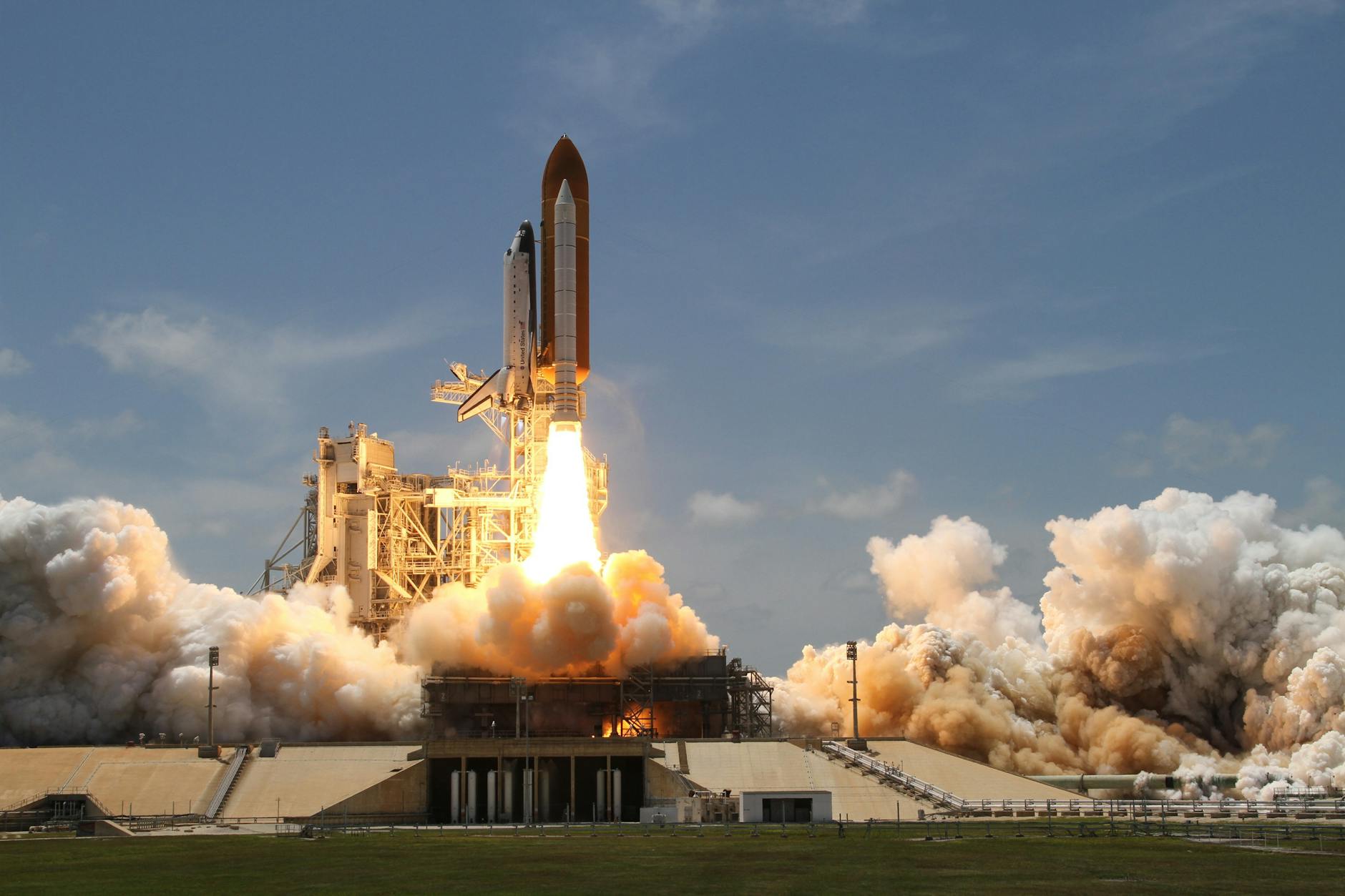
For decades, space exploration moved at a deliberate pace.
Launches were rare. Missions were state-controlled. Budgets were immense. Progress was steady—but slow.
Today, however, space technology is advancing faster than almost anyone predicted.
Reusable rockets land autonomously. Private companies deploy thousands of satellites annually. AI navigates spacecraft millions of miles from Earth. Human missions to Mars are no longer abstract ambitions—they are engineering roadmaps.
The new space era isn’t just accelerating. It’s compounding.
The Reusable Rocket Revolution
Perhaps the clearest signal of acceleration is reusable launch technology.
For most of the Space Age, rockets were disposable. After launch, boosters burned up or fell into oceans. Every mission required rebuilding hardware from scratch.
Then came SpaceX.
By successfully landing and reusing Falcon 9 boosters, SpaceX dramatically reduced launch costs and turnaround time. What once cost hundreds of millions per launch is now a fraction of that price.
Meanwhile, Blue Origin and Rocket Lab are also developing reusable systems.
The implications are profound:
- Lower launch costs
- Increased mission frequency
- Rapid deployment of satellites
- Expanded commercial access to space
Much like cloud computing transformed software scalability—discussed in Cloud Computing Became Essential Almost Overnight—reusable rockets are transforming space scalability.
Satellite Megaconstellations and Global Connectivity
Beyond rockets, satellite deployment has surged dramatically.
SpaceX’s Starlink constellation alone includes thousands of low-Earth orbit satellites, providing high-speed internet in remote regions.
Similarly, OneWeb is building its own global broadband network.
These megaconstellations:
- Expand global internet access
- Enhance military and maritime communication
- Support disaster recovery connectivity
- Enable real-time global data networks
As 5G and edge computing expand—explored in How 5G Is Quietly Transforming Connectivity—space-based infrastructure increasingly complements terrestrial networks.
Space is no longer distant. It is embedded in everyday digital life.
AI and Autonomous Spacecraft
Another driver of rapid advancement is artificial intelligence.
Deep-space missions require autonomy. Communication delays between Earth and spacecraft can span minutes or hours.
Agencies like NASA and the European Space Agency now integrate AI into:
- Autonomous navigation systems
- Hazard avoidance during landing
- Data prioritisation for transmission
- Predictive equipment maintenance
This convergence aligns with trends discussed in AI Is Becoming a Powerful Cybersecurity Weapon, where AI shifts systems from reactive to predictive.
In space, that shift is mission-critical.
Commercial Spaceflight and the Privatisation of Orbit
For most of history, space belonged exclusively to governments.
Today, private industry is redefining access.
Virgin Galactic has launched commercial suborbital flights. Meanwhile, private astronauts regularly travel to the International Space Station aboard SpaceX Crew Dragon missions.
This commercialization introduces:
- Space tourism markets
- Private research missions
- Orbital manufacturing opportunities
- New funding models for exploration
Consequently, innovation cycles accelerate. Competition increases. Capital flows more freely.
Space is transitioning from a public project to a commercial ecosystem.
Mars, the Moon, and Deep-Space Ambitions
Ambitions are also expanding outward.
NASA’s Artemis program aims to return humans to the Moon as a stepping stone toward Mars. Simultaneously, SpaceX’s Starship is designed for interplanetary travel.
The difference this time? Infrastructure is being built with long-term habitation in mind:
- Lunar bases
- In-situ resource utilization
- Sustainable propulsion systems
Advancements in materials science—outlined in Smart Materials Could Power the Next Industrial Shift—enable lightweight, heat-resistant composites essential for deep-space missions.
Unlike the Apollo era, the goal is permanence, not symbolic arrival.
Space-Based Earth Solutions
Ironically, one of space technology’s greatest impacts is on Earth itself.
Satellites now power:
- Climate monitoring
- Precision agriculture
- Disaster prediction
- Urban planning
- Supply chain logistics
Organisations like the National Oceanic and Atmospheric Administration rely on advanced satellites for real-time environmental tracking.
In this sense, space technology is not separate from terrestrial progress—it enhances it.
Miniaturisation and CubeSats
Another accelerant is miniaturisation.
CubeSats—small, modular satellites—dramatically lower barriers to entry. Universities, startups, and even high schools can now launch experiments into orbit.
This democratisation resembles the rise of open-source software—discussed in Open Source Is Driving Innovation Faster Than Companies—where access fuels exponential experimentation.
When access expands, innovation compounds.
Challenges and Risks
However, rapid advancement introduces new concerns:
- Orbital debris and space congestion
- Militarisation of space
- Regulatory fragmentation
- Environmental impact of launches
International cooperation becomes increasingly necessary to ensure sustainable space development.
Without governance, acceleration could lead to instability.
The Economic and Strategic Stakes
The global space economy is projected to reach trillions in value within decades.
Sectors benefiting include:
- Telecommunications
- Earth observation
- Defense
- Space tourism
- In-orbit manufacturing
Nations now view space capability as strategic infrastructure—comparable to cybersecurity or energy independence.
In that context, rapid advancement is not merely technological—it is geopolitical.
The Bigger Picture: Exponential Momentum
What makes modern space technology different is not just capability. It is velocity.
Reusable rockets reduce cost. Lower cost increases launch frequency. More launches expand infrastructure. Infrastructure accelerates innovation.
This feedback loop mirrors the exponential growth patterns seen in cloud computing, AI development, and biotechnology.
Space is no longer advancing linearly.
It is accelerating exponentially.
The Future: From Frontier to Framework
The early Space Age treated space as a frontier.
The new era treats space as infrastructure.
Communication networks, climate systems, navigation services, and defence capabilities increasingly depend on orbital assets.
As launch costs fall, AI improves autonomy, and materials science enhances spacecraft durability, the pace of innovation will likely continue exceeding expectations.
Space technology is not just advancing faster than expected.
It is redefining what is possible—both beyond Earth and here on it. Read More

Latest from Our Blog
Discover a wealth of knowledge on software development, industry insights, and expert advice through our blog for an enriching experience.
-

Next-Gen Batteries and Energy Storage: The Technology Powering the Clean Energy Revolution
The global energy transition has a storage problem. Solar panels don’t produce electricity at night.…
-

AI in Climate Modelling and Mitigation: How Intelligent Systems Are Shaping Earth’s Future
Humanity’s climate challenge is vast and complex. Rising temperatures, changing weather patterns, biodiversity loss, and…
-

Clean Tech Investing in 2026: Where Capital Is Flowing and Why It Matters
Clean technology is no longer a cottage industry limited to niche sustainability funds or CSR…


Leave a Reply