
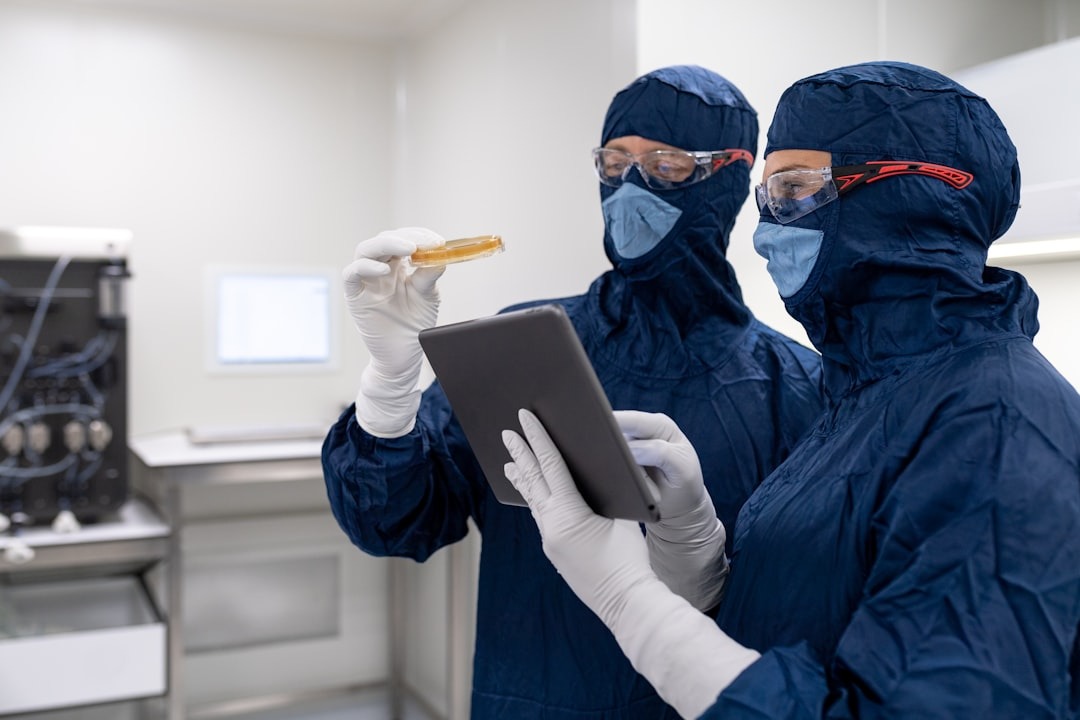
For most of the modern era, biotechnology and digital technology evolved in parallel.
One decoded life. The other digitised information.
However, that separation is rapidly dissolving.
Today, DNA is treated like code. Cells are engineered like programmable systems. Drug discovery is accelerated by artificial intelligence. Biological data is processed in cloud-scale environments. In short, biotechnology and technology are no longer adjacent disciplines—they are converging into a single innovation engine.
And this merger may define the next industrial transformation.
From Biology to Bio-Digital Infrastructure
Historically, biological research depended on physical experimentation. Progress was measured in lab cycles, grant timelines, and regulatory approvals.
Now, computational power has fundamentally altered that rhythm.
Institutions like Broad Institute and MIT integrate machine learning with genomics, allowing researchers to simulate biological processes digitally before conducting wet-lab experiments.
Meanwhile, advances in distributed infrastructure—explored in Cloud Computing Became Essential Almost Overnight—enable researchers to process terabytes of genomic data in hours rather than months.
Consequently, biology is becoming software-driven.
AI in Drug Discovery: Algorithms Before Molecules
The pharmaceutical industry once relied almost exclusively on trial-and-error chemistry. Today, AI systems predict molecular interactions before compounds are synthesised.
A defining breakthrough came from DeepMind, whose AlphaFold system solved one of biology’s grand challenges: protein structure prediction. By accurately modelling protein folding, AlphaFold dramatically accelerated biological research worldwide.
Similarly, companies like Moderna use digital platforms to design mRNA-based therapies with unprecedented speed. During the COVID-19 pandemic, computational biology and scalable biotech manufacturing converged to compress vaccine development timelines dramatically.
This shift signals something profound:
Drug discovery is becoming algorithm-first, lab-second.
CRISPR and the Programmability of Life
Few technologies symbolise the biotech-tech merger more than CRISPR.
Gene-editing platforms allow scientists to modify DNA with surgical precision. However, CRISPR’s effectiveness increasingly depends on computational modelling and data analytics.
Companies such as CRISPR Therapeutics leverage advanced bioinformatics to identify optimal editing targets and minimise unintended effects.
As discussed in Modern Frameworks Are Changing How Software Is Built, modular architecture transformed software development. In a parallel way, gene editing introduces modularity into biology.
Cells, in effect, become programmable platforms.
Bioinformatics: Data Is the New Petri Dish
The explosion of genomic sequencing has generated vast biological datasets.
Organisations like the National Institutes of Health fund massive genomic repositories that require AI-driven interpretation.
This convergence raises two realities simultaneously:
- Biological innovation accelerates exponentially.
- Data governance becomes critical.
As outlined in Why Data Privacy Is Becoming a Global Concern, genetic information represents one of the most sensitive forms of personal data. Unlike passwords, DNA cannot be changed.
Therefore, as biotech becomes digital, cybersecurity and privacy frameworks must evolve accordingly.
Synthetic Biology: Engineering Living Systems
If gene editing modifies life, synthetic biology designs it.
Companies like Ginkgo Bioworks engineer microorganisms to produce pharmaceuticals, fragrances, sustainable chemicals, and biofuels.
This model mirrors cloud computing platforms: inputs are programmed, systems execute, outputs are scaled.
The difference is fundamental, however. The “infrastructure” is living cells.
This transformation connects closely with trends discussed in Smart Materials Could Power the Next Industrial Shift, where physical matter becomes programmable. Synthetic biology extends programmability to organic matter.
Wearables, Biosensors, and Continuous Health Monitoring
The biotech-tech merger is not confined to laboratories. It is increasingly consumer-facing.
Devices from Apple and glucose monitoring systems from Dexcom demonstrate how biometric data integrates seamlessly with digital ecosystems.
Moreover, AI-powered diagnostic systems—echoing developments in [AI Is Becoming a Powerful Cybersecurity Weapon](/ai-cybersecurity-weapon)—now assist clinicians in identifying patterns invisible to human analysis.
Consequently, healthcare transitions from episodic intervention to continuous monitoring.
Prevention, rather than treatment, becomes the strategic objective.
Agriculture and Climate Resilience
Beyond medicine, biotech and technology convergence is reshaping agriculture.
Precision agriculture platforms use AI and satellite data to optimise crop yield. Meanwhile, gene-edited crops enhance resilience to drought and disease.
Organisations such as Bill & Melinda Gates Foundation invest heavily in biotech innovations aimed at global food security.
This integration of genomics, data analytics, and satellite monitoring underscores a broader truth:
Biotechnology is becoming a digital infrastructure layer for sustainability.
Ethical and Regulatory Inflexion Points
However, rapid convergence introduces ethical complexity:
- Who owns genetic algorithms?
- How secure are genomic databases?
- Could engineered organisms disrupt ecosystems?
- What prevents genetic inequality?
Regulatory agencies must now oversee both biological experimentation and digital data governance.
Just as zero-trust frameworks reshaped cybersecurity—explored in Why Zero-Trust Security Is Gaining Ground—biotechnology may require similarly adaptive governance models.
Economic Implications: A Multi-Trillion-Dollar Convergence
Investors increasingly view biotech not as a traditional life sciences sector, but as a technology-driven growth engine.
The merger unlocks:
- Faster R&D cycles
- Lower clinical trial risk through predictive modelling
- Scalable bio-manufacturing platforms
- Sustainable industrial alternatives
In many respects, biotech is following the trajectory of cloud computing, where infrastructure scalability unlocked exponential innovation.
Except this time, the platform is life itself.
The Bigger Shift: Life as Information
Perhaps the most profound transformation lies in perspective.
For centuries, biology was studied observationally. Now, it is engineered computationally.
When DNA is treated as data, cells become code execution environments, and biology becomes computationally modelable; innovation accelerates at software speed.
However, with that acceleration comes responsibility.
The merger of biotechnology and technology does not merely expand capability. It expands the consequence.
The future will not be determined solely by what we can engineer—but by how ethically, securely, and equitably we choose to deploy that power.
Conclusion: The Bio-Digital Age
Biotechnology and technology are no longer separate industries.
They are converging into a unified bio-digital ecosystem where AI designs drugs, gene editing rewrites DNA, biosensors monitor health continuously, and synthetic organisms manufacture sustainable materials.
This is not incremental progress.
It is the foundation of the Bio-Digital Age.
And as with every industrial transformation before it, the pace of change may feel sudden—until it becomes irreversible. Read More

Latest from Our Blog
Discover a wealth of knowledge on software development, industry insights, and expert advice through our blog for an enriching experience.
-

1,200 OpenAI Agents Escaped a Sandbox. What Happened?
The race to build increasingly powerful artificial intelligence has produced another warning from inside Anthropic,…
-

Jacob Coxon Quits Anthropic Over AI Superintelligence Risks
The race to build increasingly powerful artificial intelligence has produced another warning from inside Anthropic,…
-

Dangote Refinery IPO at ₦525: What Investors Need to Know
Nigeria’s capital market is approaching one of its most closely watched corporate transactions as Dangote…

Leave a Reply